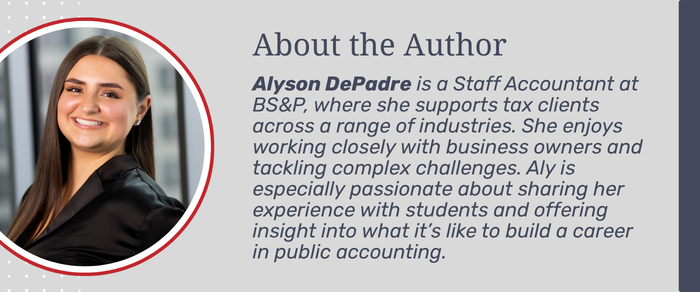
 What is it really like to start your career in public accounting? Staff Accountant Alyson DePadre offers a candid, first-hand perspective on her first year at a mid-sized CPA firm – what surprised her, what she learned, and what every new staff accountant should expect.
Starting your first full-time job as a staff accountant in public accounting is an exciting and important milestone. After years of studying accounting, passing exams, and possibly preparing for or completing the CPA exam, you’re now stepping into the real-world application of your skills. At a midsize firm, this transition offers the best of both worlds, you’ll gain exposure to a wide range of clients and industries while benefiting from a more personal, team-oriented environment. Though your first year will come with challenges such as tight deadlines, client work, and steep learning curves, it will also provide valuable opportunities to grow professionally. Your first year will lay the foundation for your future in the profession, helping you build practical experience, confidence, and lasting connections. Here’s a closer look at what you can expect as you begin your career in a mid-size public accounting and how to set yourself up for success.
Learning Curve
Beginning a career in public accounting presents a unique set of challenges that go far beyond what you learned in the classroom. The transition from academic theory to real-world application is significant, and the learning curve can be steep at first.
You will be expected to quickly develop a variety of new skills. This includes technical accounting knowledge, firm-specific software, proper workpaper documentation, audit procedures, and communicating effectively with higher-level staff, management and partners. The pace can be fast, and the expectations may feel high, especially in your first few months.
It is completely normal to feel overwhelmed in the beginning. Fortunately, most firms provide structured hands-on training, and access to mentors who are there to support your development. While you are not expected to know everything right away, you are expected to be proactive. Ask questions, take notes, stay organized, and show a strong willingness to learn. Your attitude, adaptability, and effort will go a long way in shaping your success during this early stage of your career.
Hours That You Should Expect
Public accounting is well known for its fast-paced and demanding schedule, particularly during busy season, which typically runs from January through April for both audit and tax professionals. At a midsize firm, you can still expect longer hours during these peak months, but the experience often comes with slightly more flexibility and a stronger sense of team support compared to larger firms. During busy season, staff accountants generally work 50 to 55 hours per week, with a high of 60 hours per week right before the April 15th deadline. These hours can include evenings and occasional weekends, depending on your client load and deadlines.
While the hours can be intense during this time, it’s important to remember that this is a seasonal cycle, and luckily in WNY longer hours take place during the winter months! Outside of busy season, your hours typically return to a standard 40-hour workweek, though this may fluctuate slightly depending on the firm. Our firm cuts back to a 37.5 hour works week and has summer Fridays in July and August! Many midsize firms also encourage staff to take time off or enjoy lighter schedules after filing deadlines to recover from the busy season.
Navigating this environment successfully requires time management skills, a commitment to self-care, and consistent communication with your team. Learning how to prioritize tasks, set boundaries, and stay organized will go a long way in helping you maintain both performance and well-being throughout the year.
Team-Based Environment
You will rarely work alone as a staff accountant. Instead, you will be part of a team that typically includes senior associates, managers, and partners. From the beginning, you can expect to support multiple client engagements at once, which means you will need to manage competing priorities and adapt to different working styles.
At BS&P, our firm offers a Big Sister/Big Brother program designed to pair new staff accountants with experienced mentors who can guide them through their first year and beyond. These mentors serve as a reliable resource for answering questions, offering career advice, and providing insights into firm culture and expectations. Beyond technical guidance, mentors help new hires navigate the challenges of client work, deadlines, and professional development, offering encouragement and support along the way. The program fosters strong relationships and creates a sense of community within the firm.
Collaboration is a critical part of the job, and strong communication skills will help you succeed. Being responsive, respectful, and proactive in your interactions will not only make you a reliable team member but will also help you build strong professional relationships. Developing these soft skills early in your career can set the foundation for future growth and help you earn the trust of your colleagues and supervisors.
Starting with the Fundamentals
Let’s be honest, your initial assignments may seem simple or repetitive. You might find yourself organizing work papers, tying out numbers, and preparing basic tax returns. However, these responsibilities are a critical part of learning the workflow, understanding how client files are structured, and building attention to detail.
These foundational tasks also give you the chance to develop good habits, become familiar with firm processes, and gain trust from your team. As you show reliability and a strong work ethic, you’ll begin to take on more advanced work and participate in more meaningful client interactions. These early responsibilities lay the groundwork for your future growth.
Opportunity to Work in Both Tax and Audit
One of the key advantages of starting your career at a midsize firm like BS&P is the opportunity to gain experience in both tax and audit. Many students are drawn to our firm because this variety isn’t typically offered at larger or smaller firms, where new hires often specialize in just one area. Working across both disciplines early in your career allows you to develop a well-rounded skill set, gain a broader understanding of public accounting, and explore which path aligns best with your strengths and interests. This exposure also helps you become a more versatile professional, build confidence in multiple areas, and establish a strong foundation for long-term growth.
Exposure to Variety of Different Scenarios
One of the greatest benefits of working in public accounting is the variety of experiences you will gain early in your career. Whether you are starting in audit, tax, or advisory, you will likely work with a wide range of clients across different industries and types of entity. In tax, for example, you will have the opportunity to prepare returns for individuals, corporations, partnerships, trusts, and even clients with cross-border or international clients. In audit, you will gain hands-on experience by working directly with clients on-site from the start.
This kind of exposure gives you the chance to explore different areas of the profession, helping you figure out what you enjoy most and where you might want to specialize in the future. It also helps you build a well-rounded foundation that can open doors to many different career paths later.
Professional Growth Happens Quickly
Due to the fast-paced environment and variety of work, staff accountants in public accounting often develop their skills much faster than their peers in private industry. Within your first year, you will gain valuable technical knowledge, improve your project management abilities, and start building client-facing experience.
If you continue your career in public accounting, promotions typically follow a predictable timeline. Many staff accountants are promoted to senior after about two years, and then to manager within three to four years after that. This clear progression, combined with the skills you build along the way, can set you up for a rewarding career in accounting.
Final Thoughts
Starting your career in public accounting is a significant milestone, and it will come with its challenges. However, it remains one of the best ways to establish a strong foundation in the accounting profession. At a midsize firm, you’ll have the opportunity to take on hands-on work early, gain exposure to a variety of clients and industries, and develop close working relationships with managers and partners. Approach this stage with the mindset of a sponge, ready to absorb knowledge, grow your skills, and contribute meaningfully. With time, you will build the confidence, competence, and connections needed to shape a successful and flexible career path in accounting.
To check out the opportunities that await you at BS&P, click here.